
Base Editing Technology Developed at Rutgers Licensed to Agriscience Company Corteva

Gene editing technology invented at Rutgers, The State University of New Jersey, has been licensed to Corteva, a global agriscience company, to support development of next-generation solutions for agriculture.
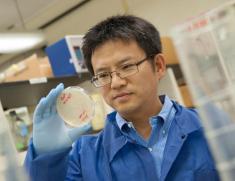
Developed by Rutgers Robert Wood Johnson Medical School professor Victor Shengkan Jin and his then PhD student, Juan-Carlos Collantes, the technology is an RNA-Aptamer-Mediated Base Editing system. It can modify the genetic code at the individual base level in a cell or an organism and could be used for precision genetic engineering in gene therapy, cell therapy, and agricultural improvement. The innovation received a 2022 Edison Patent Award in biotechnology for its use in the field of human health.
"Our base editing technology provides a powerful tool for mimicking Mother Nature to improve agricultural plant traits at a scale and speed that was unthinkable before," said Jin. "This tool would surely help to accelerate agriculture innovations, to address the many challenges faced in different regions of the world, such as food scarcity, nutritious food variety, favorable taste variety, and crop strains farmable in harsh environments.”
“Sustainability and durability of crops and plants is a key issue of our time, and this technology developed by Drs. Jin and Collantes has the ability to be a gamechanger in this field,” said Michael E. Zwick, PhD, senior vice president for research and head of Rutgers’ Office for Research. “Rutgers has long been a leader in addressing the agricultural challenges of today and tomorrow, and we look forward to seeing the impact this technology will have.”
According to Jin, the base editing technology is uniquely positioned for agricultural applications. It does not introduce any new genes into the crops and thus does not create any GMOs. Instead, the technology quantitatively enhances the crops’ own existing traits, leading to desired strains with more nutrients, higher yield, stronger stalks, and deeper roots, for example. Historically, these favorable strains were found in the wild, and only by luck.
Corteva is an international agriscience company with market-leading positions in both crop protection and seed. The company believes this technology will advance new solutions in crops such as corn, wheat, rice, and soybean.
“We’re excited to collaborate with Rutgers to further accelerate the development of gene editing technology and bring innovation to farmers,” said Wendy Srnic, vice president of biotechnology, Corteva. “We’re committed to solving the biggest challenges facing modern agriculture and meeting the needs of a growing, global population.”
“Our team is proud to support Drs. Jin and Collantes through their entrepreneurial journey, including the licensing of their innovation to Corteva,” said Deb Perez Fernandez, PhD, MBA, executive director of the Technology Transfer department within the Office for Research. “We hope this agreement serves as the beginning of a relationship that will lead to positive impacts on the world.”
“The Office for Research played a critical role in facilitating the technology development and transfer, as the Technology Transfer unit led negotiations on the license agreement,” said Jin. “Moreover, part of the agricultural research was supported by a TechAdvance® grant from the Office for Research.”