
New Course Gives Rutgers–Camden Undergraduates Hands-On Experience at Scientific Conferences

Listen Now
While many may imagine scientists working solely in a lab or out in the field, sharing discoveries with colleagues is another essential part of the scientific process. A groundbreaking new course at Rutgers University–Camden is providing undergraduate students firsthand experience presenting research to peers and colleagues at no additional cost beyond their tuition dollars.
This past fall, the university’s Institute for Empowering Equitable Education in STEM (E3-STEM Institute) launched the Conference Trip course. The course is open to all STEM undergraduates conducting research with a faculty mentor and includes preparatory sessions that guide students through conference expectations, proposal preparation, and presentation skills.
The course was developed by Kwangwon Lee, professor of biology and director of the E3-STEM Institute.
“For many years, I was able to take undergraduate researchers to national conferences with federal grants, but that funding was cut unexpectedly earlier this year,” said Lee. “Knowing how transformative these experiences are for our students, I wanted to keep the opportunity accessible, especially for students who would not otherwise be able to afford it.”
Lee approached Dean John Griffin and proposed a unique solution to the funding challenge: a three-credit experiential learning course that uses tuition revenue from students to cover their conference fees and travel costs. Griffin and the university offered their enthusiastic support for Lee’s novel approach, and by Fall 2025, the Conference Trip course was part of the university’s catalogue.

This past October, the first group of ten students in the class traveled to NDiSTEM, one of the nation’s premier multidisciplinary and multicultural STEM conferences, in Columbus, Ohio.
“The NDiSTEM conference offers rich scientific programming, cultural learning, and broad networking opportunities,” said Lee. “Students had the chance to meet peers from diverse backgrounds, hear from outstanding scientists, see the breadth of work happening across STEM fields, and learn about a wide range of STEM career paths available to them.”
“This is the kind of experience that you can never get from just the classroom alone,” said Myo Thinzar Htin Aung, a senior majoring in biology. “As a first-generation student with limited opportunities, I felt this course was like an open door to something I had always hoped to experience but never imagined I could access so early in my academic journey.”
Tiffany Chan, a junior double majoring in biology and computational & integrative biology, acknowledged that the financial support allowed her to focus exclusively on the opportunity to connect and learn from others.
“The way the course is structured, it removes the financial constraints tied to attending a national conference, which allowed me to feel much less overwhelmed and focus on preparing my research for submission,” said Chan.
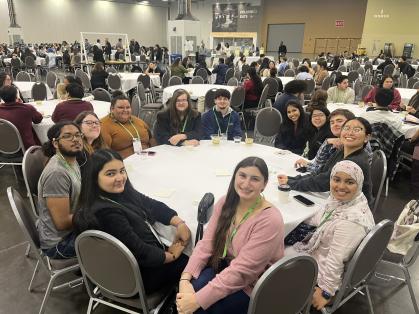
Networking with peers and professionals at the conference proved to be a particularly valuable aspect of the experience as well.
"I enjoyed meeting others, stepping out of my comfort zone, and realizing we all want to see each other succeed," said senior biology major Alan Rozenblit.
While this was the first experiential learning course offered by the E3-STEM Institute at Rutgers–Camden, planning has already begun for an expanded offering of experiential learning opportunities beginning in the fall of 2026.
“Many students describe this exposure as inspiring and eye-opening,” said Lee. “We know that to be true, so our goal is to build scalable, authentic opportunities that support all students.”