
FAME Afterschool Program Uses Video Storytelling To Inspire Next Generation of STEM Leaders

The FAME (Food, Agriculture, and Marine Ecosystems) afterschool 4-H program at Rutgers is transforming how high school students engage with science by combining in-person, science-in-action tours, interviews with scientists and collaborative video storytelling. FAME offers a unique 12-week after-school experience where students don’t just learn about science—they become active participants in scientific discovery and communication.

Funded by USDA-NIFA, the program brings high school youth into partnership with Rutgers scientists, empowering students to create compelling science video stories that bridge complex research and community understanding. High school students from Highland Park High School and Edison High School work directly with researchers in the departments of Plant Biology and Marine & Coastal Sciences, to explore cutting-edge topics like gene editing, automated phenotyping and aquaculture techniques.
FAME’s research method combines the science-in-action video storytelling model developed at Rutgers with the 4-H “Thrive” positive youth development model. Each week, youth gather in the Immersive Learning through Science Storytelling Lab where Dena Seidel (co-PI) provides the youth with science video storytelling training and supervision and Xenia Morin (Co-PI) offers lessons in agriculture and food system science. Marissa Staffen (co-PI) and Natalia Susana Hinds oversee the high school youth recruiting and coordination. As part of the project’s research, FAME collaborates with Carleton College’s Science Education Resource Center to monitor and evaluate the participating youth’s STEM learning through storytelling.
“The FAME program has been the most exciting, engaging, thought-provoking science experience that our students have ever had an opportunity to do,” said Keisha Stephens, a teacher from Highland Park High School. “Students were learning real-world science while creating a story. Our students left with the best experiences ever.”
At the end of each cohort, high school student teams share their science video stories with their communities, families and the scientists with whom they work in a FAME Showcase, which was held this year at Edison High School on December 9.
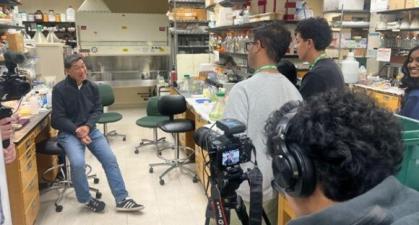
about his research studying the food security and biofuel potential of duckweed.
The FAME research team developed this innovative after-school program to study immersive STEM learning through storytelling. Rather than traditional lectures, high school students step into greenhouses, laboratories and research sites where science unfolds in real time. They interview Rutgers plant and marine food system scientists, edit video of their interviews and laboratory research in action and craft 3–6-minute video stories that make complex concepts accessible, engaging and exciting to their peers.
“I’m so glad that my alma mater, Rutgers University, and the FAME program have gotten together to bring our students into the lab where they can do real research with real Rutgers scientists,” said Charles Ross, principal of Edison High School. “Just as importantly, they find ways to tell the story of the research and let the masses find out about science in that 21st century visual way. I am so glad our students have this opportunity to see how they belong in the halls of academia.”
Colby Koutrakos, a junior in Ecology and Evolution, is involved in supporting the high school students in the program. “It’s a joy to see how quickly these high school students take their experience in labs and then create thoughtful and inspiring science stories they then share with their peers and families,” said Koutrakos.
High school student testimonials reflect the program’s transformative power. “This is my first time in a science lab and they’re really inspiring because they went through a lot of hard work to get here,” shared Jaydy, a student participant. “It’s my responsibility to help get their message across.”
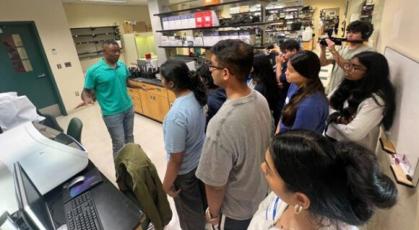
student Idrice Kue Foka, who is studying plant molecular biology
Student Aadithi added, “I interviewed Dr. Rong Di about what specific plants she’s been working on for food security.” Her partner Sai reflected on the personal growth experienced through the program: “As I saw her open herself up, I started to open myself up more too.”
High school students gain authentic experience in science communication through interviewing, video editing, writing and recording narration and then presenting their finished stories. They are also learning skills that prepare them for workforce pathways in agricultural and food system-related fields.
“In the end, FAME is not simply about agriculture or marine ecosystems,” said James Simon, Distinguished Professor in the Department of Plant Biology. “It is about giving young people the tools, and the confidence, to take their place in the story of science.”
This article is reposted with permission by the SEBS and NJAES Newsroom. Read the original article.